Shielding Personal Liberty: Decoding the Notice to Appear and Arrest Procedures Under Section 35 of the Bharatiya Nagarik Suraksha Sanhita (BNSS), 2023
Dive into the key provisions of Section 35 of the BNSS, 2023, explaining how it protects personal liberty and regulates police arrest procedures. Understand the roles of notices to appear and safeguards for vulnerable citizens.
- By
- BailNow Research Team
- Published
- Reading time
- 10 min read
On this page
Merging CrPC Sections 41 and 41A: How the New Statutory Framework Restricts Routine Police Arrests and Mandates Procedural Accountability
By Legal Editor
New Delhi: October 2026:
The transition from the colonial-era Code of Criminal Procedure (CrPC), 1973, to the Bharatiya Nagarik Suraksha Sanhita (BNSS), 2023, represents a monumental legislative shift aimed at modernizing India's criminal justice delivery mechanism. For decades, one of the most contentious issues in criminal law was the routine, mechanical resort to pre-trial arrest by police officers immediately upon the registration of a First Information Report (FIR). This practice frequently caused severe damage to personal liberty, social reputation, and professional standing long before any judicial trial or proof of guilt.
To curb this overreach, the erstwhile legal framework evolved through landmark judicial interventions—most notably the historic Supreme Court ruling in Arnesh Kumar v. State of Bihar (2014)—which mandated the use of notices of appearance under Section 41A of the CrPC for offenses punishable with imprisonment up to seven years. Under the modern BNSS framework, the legislature has taken a progressive step by consolidating and streamlining these provisions into Section 35. Section 35 unifies the power of arrest without a warrant and the statutory notice of appearance into a single, cohesive provision equipped with stricter safeguards, clearer thresholds, and unique protections for vulnerable citizens.
Understanding Section 35 of the BNSS is essential for citizens, legal practitioners, and law enforcement agencies alike, as it dictates the legal boundary between lawful investigative cooperation and arbitrary custodial deprivation.
The Core Statutory Architecture: Deconstructing Sub-Sections (1) through (7) of Section 35 BNSS
A detailed reading of Section 35 reveals a meticulously designed structure that places the burden of justification squarely on the investigative machinery before any physical detention can occur.
Statutory Principle: Arrest is never automatic upon the registration of an FIR. For offenses carrying a punishment of up to seven years, the issuance of a notice of appearance is the default rule, while arrest remains an exceptional measure requiring strict, written justification.
1. The Seven-Year Threshold and the Necessity Test [Sub-Section 1 & 2]
Under Section 35(1), a police officer may arrest a person without a warrant for a cognizable offense, but the statute introduces a strict two-pronged filter for offenses punishable with imprisonment for a term up to seven years (with or without fine):
- Reason to Believe: The officer must harbour a reasonable belief based on credible information that the person has committed the cognizable offense.
- The Necessity Condition: In addition to reasonable belief, the officer must be satisfied that arrest is necessary for one of specific statutory grounds, such as:
- To prevent such person from committing any further offense;
- For proper investigation of the offense;
- To prevent such person from tampering with or destroying evidence;
- To prevent them from making any threat, promise, or inducement to witnesses to dissuade them from disclosing facts; or
- Unless such person is arrested, their presence in court whenever required cannot be ensured.
If these necessity conditions are not met, the police officer is legally barred from executing an immediate arrest.
2. The Notice of Appearance Mechanism [Sub-Sections (3) through (6)]
What was formerly governed by Section 41A of the CrPC is now housed under Section 35(3) of the BNSS:
- Mandatory Issuance [Sub-Section 3]: In all cases where the arrest of a person is not required under the necessity tests of sub-section (1), the police officer shall issue a notice directing the individual to appear before them at a specified place and time.
- Protection Upon Compliance [Sub-Section 5]: If a citizen complies with the terms of the notice and continues to cooperate with the inquiry, they shall not be arrested for the offense mentioned in the notice, unless the officer records specific reasons in writing that subsequent circumstances necessitate custody.
- Consequences of Non-Compliance [Sub-Section 6]: If the individual fails to comply with the notice terms or refuses to establish their identity, the police officer gains the legal authority to effect an arrest, subject to any orders passed by a competent court.
3. The New Statutory Safeguard for Senior Citizens and Infirm Persons [Sub-Section (7)]
A distinctive and brand-new addition under the BNSS is Section 35(7). This sub-section provides that for offenses punishable with imprisonment of less than three years, if the person against whom an accusation is made is infirm or above sixty years of age, no arrest can be made without the prior permission of an officer not below the rank of Deputy Superintendent of Police (DSP). This introduces an extra layer of administrative oversight to protect elderly citizens from harassment or arbitrary detention.
Balancing Investigation and Liberty: The Mechanics of Compliance, Recorded Reasons, and Judicial Oversight
Why a Section 35 Notice is Not a Court Summons
A common misconception among recipients is that a notice under Section 35(3) of the BNSS is a formal summons issued by a judicial magistrate. It is not. It is an investigative communication originating from the police executive wing. However, ignoring it or treating it casually invites severe legal jeopardy.
When a notice arrives, it typically outlines:
- The specific police station and investigating officer details;
- The FIR number and the legal sections invoked (frequently utilized in matrimonial disputes under BNS Section 85/old 498A, commercial disputes, or property disagreements);
- The exact date, time, and venue for joining the inquiry.
The Requirement of "Fresh Justification" for Arrest
Recent judicial pronouncements, reinforcing the spirit of Satender Kumar Antil v. Central Bureau of Investigation, have clarified that once a notice of appearance is issued and the recipient complies, the police cannot turn around and arrest the individual arbitrarily. If an arrest is deemed necessary later, the police officer must record fresh or additional circumstances that developed during the investigation—they cannot rely solely on the original allegations that existed when the notice was first issued. This safeguard prevents investigative agencies from using a notice merely as a procedural formality to bypass legal scrutiny before executing a sudden arrest.
Comparative Matrix: Old CrPC Framework vs. Modern BNSS Section 35
Parameter / Feature | Legacy Framework (CrPC Sections 41 & 41A) | Modernized Framework (BNSS Section 35) |
|---|---|---|
Statutory Structure | Split across multiple sections (Section 41 for arrest powers, Section 41A for notice). | Consolidated into a single, comprehensive provision divided into logical sub-sections (1) to (7). |
Mandatory Notice Rule | Applicable to offenses up to 7 years via Section 41A, developed largely through judicial enforcement (Arnesh Kumar). | Codified explicitly under Section 35(3), making issuance of notice the statutory default rule when custody is unnecessary. |
Senior Citizen & Infirm Protection | No explicit threshold provision within Section 41A; relied on general judicial discretion. | Expressly introduced under Section 35(7), barring arrest for offenses under 3 years for persons above 60 or infirm without prior DSP approval. |
Written Justification for Arrest | Required recording of reasons, but enforcement varied widely across jurisdictions. | Tightened statutory mandate requiring recorded reasons for both not arresting and for making subsequent arrests. |
Technological & Digital Integration | Paper-based dispatch, physical service logs, and manual tracking of notices. | Streamlined for integration with electronic case diaries, digital communication tracking, and e-governance portals. |
Strategic Roadmap for Recipients and Legal Counsel Under Section 35 BNSS
Receiving a notice to appear under Section 35 of the BNSS requires calm, methodical, and prompt legal action:
- Verify Authenticity and Details: Immediately examine the notice to verify the FIR number, police station credentials, specific BNS sections invoked, and the exact timestamp demanded for appearance.
- Consult Criminal Defence Counsel: Never appear before an investigating officer unrepresented in sensitive matters. Engage an expert criminal lawyer to evaluate the allegations and advise on the appropriate strategy.
- Prepare a Written Representation: While personal appearance is required for questioning, filing a detailed written reply through counsel—enclosing relevant documents, alibi evidence, or clarification papers—places the recipient's bona fides officially on record before the investigation proceeds.
- Ensure Diligent Compliance: Attend the inquiry punctually on the scheduled date and time. Obtain a signed acknowledgment or receipt from the investigating officer confirming compliance to secure the protective shield of Section 35(5).
- Evaluate Pre-emptive Legal Remedies: If there is a well-founded apprehension of custodial interrogation despite cooperation, counsel should consider moving for anticipatory bail under Section 482 of the BNSS.
Conclusion: Strengthening the Rule of Law Through Proportionality
Section 35 of the Bharatiya Nagarik Suraksha Sanhita, 2023, marks a mature evolution in India's criminal procedure by legally enshrining the principle that personal liberty cannot be curtailed arbitrarily where investigative necessity is absent. By streamlining the notice-of-appearance mechanism, imposing strict writing requirements for police discretion, and introducing specialized protections for senior citizens, the provision bridges the gap between effective state investigation and constitutional human rights. As judicial oversight continues to enforce these standards, Section 35 stands as a frontline defence safeguarding citizens from unnecessary pre-trial detention.
Frequently Asked Questions (FAQs): Notice to Appear Under Section 35 BNSS
1. What is a notice to appear under Section 35 of the BNSS?
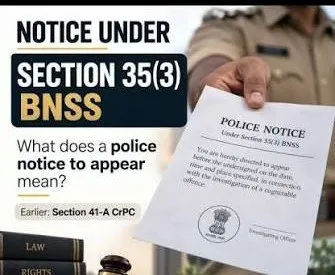
A notice to appear under Section 35(3) of the BNSS is a formal written directive issued by a police officer to an individual against whom a cognizable complaint or FIR has been filed, instructing them to join an ongoing inquiry at a specified place and time instead of being subjected to immediate arrest. It serves as the modern statutory equivalent of the old Section 41A notice under the CrPC.
2. Does receiving a Section 35 notice mean I have been formally charged or proven guilty?
Not at all. Receiving a notice does not imply guilt or form a chargesheet. It is a procedural step in the investigative phase designed to gather facts and record your version of events while protecting your personal liberty. You remain legally presumed innocent.
3. Can the police still arrest me after issuing a Section 35 notice?
In the ordinary course, if you comply with the terms of the notice and cooperate with the investigation, you cannot be arrested for that offense. However, the police retain the power to arrest you if they record valid written reasons demonstrating that subsequent circumstances (such as evidence tampering, witness intimidation, or risk of absconding) have made custodial detention indispensable.
4. What happens if I ignore or fail to comply with a Section 35 notice?
Ignoring a Section 35 notice or refusing to establish your identity gives the police officer the direct legal authority to arrest you without a warrant for the offense mentioned in the notice. Furthermore, wilful non-compliance severely weakens your legal standing and can be cited by courts to deny subsequent pre-emptive reliefs like anticipatory bail.
5. What special protections does Section 35 provide for senior citizens?
Under Section 35(7) of the BNSS, for offenses punishable with imprisonment of less than three years, if the accused person is infirm or over sixty years of age, the police cannot execute an arrest without obtaining the prior permission of an officer not below the rank of Deputy Superintendent of Police (DSP).
6. Can my lawyer appear on my behalf in response to a Section 35 notice?
No. The notice requires your personal appearance for direct questioning and recording of statements. However, your lawyer plays a vital role by advising you beforehand, accompanying you to the police station, ensuring your rights against self-incrimination are protected, and assisting in drafting formal written replies or submissions.
Related articles
 Bail Basics
BailNow.in Special Story on How to Secure Bail in Cyber Cases
This article provides a comprehensive guide on securing bail in cyber cases, addressing the legal complexities of Telegram scams and mule accounts.
9 min read
 Bail Basics
BailNow.In Special Story on Emergency Bail Guidelines
This guide provides essential information on emergency bail in India, detailing procedures, costs, and vital strategies for securing release in urgent situations.
12 min read