Clockwork Liberty: Dissecting the 60-Day and 90-Day Default Bail Timelines Under Section 187 of the BNSS, 2023
This article dissects the crucial 60-day and 90-day default bail timelines outlined in Section 187 of the BNSS, emphasizing their significance in safeguarding personal liberty within India's legal framework.
- By
- BailNow Research Team
- Published
- Reading time
- 9 min read
On this page
Decoding the Statutory Thresholds: How Section 187 BNSS Distinguishes Between Minor Offenses and Heinous Crimes for Pre-Trial Custody
By Legal Editor
New Delhi: October 2026:
The right to personal liberty under Article 21 of the Constitution of India finds its most robust procedural fortification in the doctrine of default bail—also widely known as statutory bail or compulsive bail. Unlike discretionary regular bail, which requires a meticulous judicial weighing of the merits, flight risks, and evidentiary tampering, default bail is an indefeasible right that activates automatically the moment investigative agencies fail to conclude their inquiries and file a final police report (chargesheet) within the prescribed statutory timeframe.
With the complete repeal of the colonial-era Code of Criminal Procedure (CrPC), 1973, and the implementation of the Bharatiya Nagarik Suraksha Sanhita (BNSS), 2023, the governing mechanism migrated from the erstwhile Section 167 CrPC to Section 187 of the BNSS. While the foundational timelines of 60 days and 90 days have been retained, the new statutory language, coupled with modernized police custody flexibility and strict judicial interpretations, has fundamentally altered how criminal defence lawyers and trial courts compute pre-trial detention limits.
The Core Arithmetic: Unpacking the 60-Day and 90-Day Tracks Under Section 187 BNSS
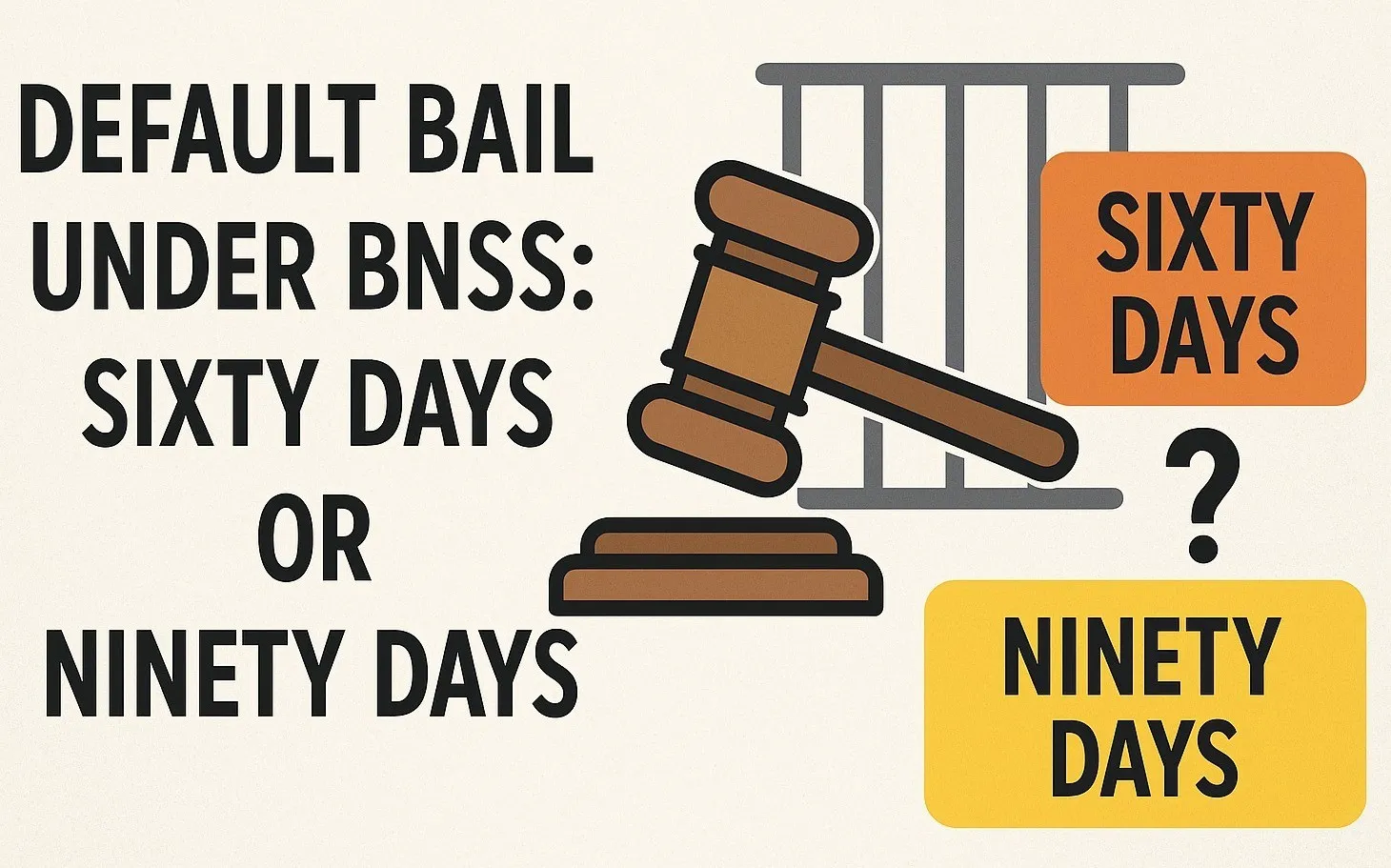
Section 187(3) of the BNSS establishes clear-cut outer limits for pre-trial detention during an ongoing criminal investigation. The duration within which an investigating agency must file a chargesheet is strictly dictated by the gravity and maximum punishment prescribed for the alleged offense:
- The 90-Day Track: Applies strictly to offenses punishable with death, imprisonment for life, or imprisonment for a term of ten years or more. This category covers grave felonies, organized crimes, major economic offenses under specific penal provisions, and severe violent crimes.
- The 60-Day Track: Governs all other offenses. This covers general penal infractions where the maximum punishment does not cross the threshold of ten years, or where no mandatory minimum sentence of ten years is stipulated by law.
The Jurisprudential Nuance: "Ten Years or More" vs. "Imprisonment Up to Ten Years"
Recent rulings by various High Courts analyzing Section 187 BNSS have tackled a critical ambiguity regarding offenses punishable with a maximum of ten years. Jurisprudence clarifies that if an offense carries a maximum sentence of ten years without a mandatory minimum requirement of ten years, it falls securely under the 60-day default bail track rather than the extended 90-day window. This restrictive interpretation ensures that investigative agencies cannot stretch pre-trial incarceration under the guise of an elongated 90-day timeline for mid-tier offenses.
The Crucial Police Custody Window, Split Remand Rules, and Accrual Mechanics
The Innovation of Split Police Custody [Section 187(2)]
One of the most consequential structural changes introduced under Section 187 of the BNSS is the re-engineered framework for police custody:
- Under the legacy CrPC framework, police custody was traditionally restricted to the first 15 days following initial arrest, usually consumed in one continuous block.
- Under Section 187(2) of the BNSS, while the aggregate maximum ceiling for police custody remains capped at 15 days, magistrates are now empowered to authorize this custody in separate parts across a wider initial window.
- For cases falling under the 60-day default timeline, the 15 days of police custody can be distributed across the first 40 days.
- For cases governed by the 90-day default timeline, police custody can be utilized at intervals across the first 60 days.
This legislative shift gives investigators greater flexibility to seek custodial interrogation if fresh evidence emerges mid-investigation, while introducing complex operational challenges for defence counsels monitoring remand durations.
How the Default Bail Clock Operates and Expires
- Day Zero Calculation: The statutory clock begins ticking strictly from the date of the first remand order passed by the Magistrate, excluding the actual date of arrest itself.
- Midnight Expiry: The 60th or 90th day terminates at midnight. If the investigating agency fails to submit a valid, complete chargesheet before this deadline, the right to default bail immediately crystallizes in favor of the accused.
- The Golden Rule of Application: Following landmark constitutional benchmarks (such as Sanjay Dutt v. State and Uday Mohanlal Acharya), the right must be invoked by filing a formal written bail application before the chargesheet is eventually filed. If the police manage to file, the chargesheet even a few hours late—after the accused has formally applied for and expressed readiness to furnish default bail—the right stands extinguished. However, if the application is filed on or after the 61st/91st day prior to the chargesheet, the court is legally bound to release the accused.
Comparative Matrix: Old Section 167 CrPC vs. New Section 187 BNSS
Parameter / Feature | Legacy Framework (Section 167 CrPC) | Modernized Framework (Section 187 BNSS) |
|---|---|---|
Section Nomenclature | Section 167 of the Code of Criminal Procedure, 1973. | Section 187 of the Bharatiya Nagarik Suraksha Sanhita, 2023. |
Default Bail Timelines | 60 days for general offenses; 90 days for serious offenses carrying death, life imprisonment, or 10 years. | Retains 60-day and 90-day outer limits with tighter judicial scrutiny over threshold definitions. |
Police Custody Mechanics | Strictly restricted to a continuous 15-day block, typically confined to the early stages of remand. | Total 15-day cap preserved, but permissible in split parts across the first 40 days (60-day track) or 60 days (90-day track). |
Executive Magistrate Powers | Restricted powers of detention when judicial magistrates were unavailable. | Explicitly capped at a maximum of 7 aggregate days of detention before mandatory referral to a judicial magistrate. |
Technological Integration | Dependent on physical case diaries, manual registers, and physical production of the accused. | Synchronized with electronic case management, digital record-keeping, and video-conferencing protocols for routine remands. |
Strategic Roadmap for Defence Practitioners Under Section 187 BNSS
Navigating default bail applications requires absolute precision in tracking dates and understanding procedural technicalities:
- Meticulous Calendar Tracking: Defence counsels must maintain day-wise computation logs starting precisely from the initial remand date, keeping alert to whether the case falls under the 60-day or 90-day track.
- Immediate Application Filing: The moment the 60th or 90th day expires without a chargesheet, a written default bail application under Section 187(3) must be filed immediately, complete with willingness to offer sureties.
- Challenging "Incomplete" Chargesheets: If the prosecution files a perfunctory chargesheet solely to defeat default bail without substantive investigation materials or forensic reports, defence teams can cite established Supreme Court precedents to argue that an incomplete report does not lawfully halt the default bail clock.
Conclusion: Safeguarding Constitutional Liberty Against Investigative Lapses
Section 187 of the BNSS, 2023, serves as a vital legislative check against arbitrary and indefinite pre-trial detentions. By clearly delineating the 60-day and 90-day tracks while reforming police custody dynamics, the statute maintains a delicate equilibrium between effective state prosecution and the inviolable personal liberty guaranteed under Article 21. As trial courts and high courts continue to refine jurisprudence around the BNSS, adherence to strict statutory timelines remains the ultimate safeguard for upholding justice in India's criminal courts.
Frequently Asked Questions (FAQs): Default Bail Timelines Under Section 187 of the BNSS, 2023
1. What is default bail under Section 187 of the BNSS?
Default bail—also referred to as statutory or compulsive bail—is an indefeasible legal right that automatically grants pre-trial release to an accused person if the investigative agency fails to complete its investigation and file a final police report (chargesheet) within the mandatory statutory timeframe. It acts as a crucial safeguard under Article 21 of the Constitution to prevent indefinite or prolonged pre-trial detention.
2. What is the difference between the 60-day and 90-day timelines under Section 187?
The outer limit for filing a chargesheet depends strictly on the severity and maximum punishment prescribed for the alleged offense:
- The 90-Day Track: Applies to offenses punishable with death, imprisonment for life, or an imprisonment term of ten years or more.
- The 60-Day Track: Governs all other offenses where the maximum sentence does not reach the ten-year threshold or where no mandatory minimum sentence of ten years is stipulated by law.
3. How does the court calculate the 60-day or 90-day statutory clock?
The calculation begins strictly from the date of the first judicial remand order passed by the Magistrate, excluding the actual date of arrest. The statutory period terminates precisely at midnight on the 60th or 90th day. If the chargesheet is not filed by this deadline, the right to default bail immediately crystallizes in favor of the accused.
4. What happens if the police file an "incomplete" chargesheet just to block default bail?
If the prosecution submits a perfunctory, incomplete report lacking mandatory investigation components or key forensic files solely to defeat the statutory deadline, defence counsels can challenge its validity. Established judicial precedents dictate that an incomplete chargesheet filed merely as a device to bypass statutory limits does not extinguish the right to default bail.
5. Can an accused still claim default bail if the police file the chargesheet late?
The timing of the formal bail application is critical. Following settled constitutional jurisprudence, the accused must file a written default bail application before the chargesheet is eventually filed. If the police submit the chargesheet after the accused has formally applied for and expressed readiness to furnish default bail on or after the 61st or 91st day, the court is legally bound to grant release. However, if the chargesheet is filed even a few hours before the default bail application is submitted, the right stands extinguished.
6. What are the key changes in police custody rules under Section 187 compared to the old CrPC?
While the aggregate maximum limit for police custody remains capped at 15 days, the legacy requirement that custody must be continuous and confined exclusively to the early stages of remand has been reformed. Under Section 187(2) of the BNSS, magistrates are empowered to authorize police custody in separate parts across a broader initial window—within the first 40 days for the 60-day track, or within the first 60 days for the 90-day track.
Related articles
- Default Bail
Default Bail: Understanding the Timeline and Key Dates
Default bail turns on a small number of dates. Why custody commencement, the applicable period and the filing date of the final report need to be established precisely, and verified against current law.
7 min read
 Anticipatory Bail
Shielding Family Ties: Has the BNSS Changed the Rules for Anticipatory Bail in Matrimonial Disputes and In-Law Cases?
This article examines the transformative impact of the BNSS 2023 on anticipatory bail rules for in-laws amid matrimonial disputes, emphasizing judicial discretion and legal protections.
7 min read