Decoding Personal Liberty: A Comprehensive Step-by-Step Guide to the Bail Process in the Indian Criminal Justice System
This comprehensive guide details the bail process in the Indian criminal justice system, outlining steps necessary for securing personal liberty and understanding bailable vs non-bailable offenses.
- By
- BailNow Research Team
- Published
- Reading time
- 10 min read
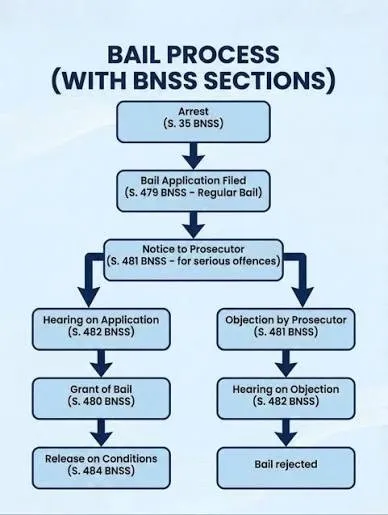
Navigating the complexities of criminal procedure requires a clear understanding of statutory rights, court hierarchies, and documentation requirements under the Bharatiya Nagarik Suraksha Sanhita (BNSS), 2023.
From distinguishing between bailable and non-bailable offenses to executing bonds and managing surety verifications, this in-depth guide breaks down every procedural milestone required to secure liberty.
By Legal Editor
New Delhi: October 14, 2026:
At the heart of constitutional democracy lies the sacrosanct guarantee of personal liberty enshrined under Article 21 of the Constitution of India. No person can be deprived of their life or personal liberty except according to procedure established by law. When an individual is accused of a crime, detained by law enforcement, or facing criminal prosecution, the legal mechanism of bail acts as the vital bridge between state investigative powers and individual freedom.
In landmark pronouncements—most notably Satender Kumar Antil v. Central Bureau of Investigation (2022)—the Supreme Court of India reiterated the foundational maxim of criminal jurisprudence: "Bail is the rule, jail is the exception." Pre-trial detention is designed to ensure the integrity of the investigation and the presence of the accused during trial, not to serve as pre-trial punishment.
With the historic transition from the colonial-era Code of Criminal Procedure (CrPC), 1973, to the Bharatiya Nagarik Suraksha Sanhita (BNSS), 2023, the procedural architecture governing arrest, remand, and bail underwent significant modernization. This comprehensive investigative feature provides a meticulous, step-by-step breakdown of how the bail process operates in India, equipping litigants, legal practitioners, and everyday citizens with actionable knowledge.
Phase 1: Categorization of Offenses — Bailable vs. Non-Bailable
Before drafting or filing any bail application, the very first step is examining how the specific penal offense is classified under the First Schedule of the BNSS. The entire trajectory of the bail process depends on this statutory classification.
1. Bailable Offenses (Section 478 BNSS)
In offenses classified as bailable (such as minor hurt, defamation, or certain forms of cheating), bail is a matter of absolute legal right.
- Police Station Bail: If a person is arrested for a bailable offense without a warrant and is willing to furnish bail, the officer-in-charge of the police station must release them. The police have zero judicial discretion to refuse bail if the accused is ready to provide the required security.
- Indigent Provisions: If an accused person is indigent and unable to furnish financial sureties within a week of arrest, the law mandates that the court or police must release them on a personal bond without sureties.
2. Non-Bailable Offenses (Section 480 BNSS)
In offenses classified as non-bailable (such as murder, extortion, dacoity, or serious economic offenses), bail is not a matter of right; it is a matter of judicial discretion.
- The accused cannot demand release as a matter of course from the police station (with limited exceptions for women, minors under 16, or sick/infirm individuals under special provisos).
- Securing release requires moving a formal judicial application before the competent criminal court.
Phase 2: The Four Pillars — Types of Bail in India
Depending on the stage of investigation or apprehension, Indian criminal law provides four primary categories of bail:
Type of Bail | Governing Statutory Provision | When Is It Filed / Granted? | Primary Objective |
|---|---|---|---|
Regular Bail | Sections 480 & 483 BNSS (Old: Sec 437 & 439 CrPC) | Filed after the accused has been arrested and placed in police or judicial custody. | To secure release during the pendency of investigation or trial. |
Anticipatory Bail | Section 482 BNSS (Old: Sec 438 CrPC) | Filed before arrest, when an individual apprehends being arrested for a non-bailable offense. | To protect individuals from harassment, false implication, or arbitrary arrest. |
Default / Statutory Bail | Section 187 BNSS (Old: Sec 167(2) CrPC) | Triggered automatically when the investigating agency fails to file a charge sheet within 60 or 90 days. | To penalize investigative delays and protect undertrials from indefinite incarceration. |
Interim Bail | Judge-made / Article 21 & 226 | Granted as a short-term, temporary measure while a regular or anticipatory bail petition is pending. | To prevent immediate irreparable harm (e.g., medical emergencies). |
Phase 3: Step-by-Step Procedure for Obtaining Regular Bail
When an individual has been arrested for a non-bailable offense and remanded to judicial custody, navigating the regular bail process involves a rigorous, multi-step protocol.
Step 1: Arrest and Remand Management
Upon arrest, the police must produce the accused before the nearest Judicial Magistrate within 24 hours (excluding travel time). The Magistrate evaluates the legality of the arrest and authorizes custody—either police custody (for interrogation) or judicial custody (detention in jail). Once the accused is in judicial custody, the path to filing a regular bail application opens.
Step 2: Compiling Mandatory Documentation
Before a lawyer can draft an effective bail petition, an exhaustive set of documents must be gathered:
- Certified copy of the FIR (First Information Report): To verify the exact penal sections and allegations.
- Arrest Memo: To check compliance with constitutional and statutory arrest guidelines.
- Remand Orders: Copies of orders passed by the Magistrate authorizing detention.
- Vakalatnama: Executed by the accused (often jail-attested if the accused is inside prison) authorizing the advocate to represent them.
- Medical Records & Antecedent Details: Supporting documents if medical grounds are pleaded, along with disclosures of any past criminal history.
Step 3: Drafting the Bail Application
Drafting a robust bail application under Section 480 or 483 BNSS requires precision:
- Jurisdictional Court Selection: Applications for offenses carrying lesser punishments are filed before the Judicial Magistrate; more severe offenses (punishable exceeding 7 years or life/death) go to the Sessions Court or High Court.
- The Disclosure Paragraph: In line with strict judicial oversight, the application must contain full disclosures regarding any prior bail applications, rejections, or outstanding non-bailable warrants (NBWs) across India. Concealing antecedents can result in immediate rejection or subsequent bond cancellation.
- Core Legal Grounds: The petition must emphasize key factors: lack of flight risk, no possibility of tampering with evidence or threatening witnesses, deep roots in society, and whether continued incarceration serves any active investigative purpose.
Step 4: Filing and Serving Advance Copies
The compiled application is filed at the court registry. Crucially, an advance copy of the bail application and annexures must be served upon the Public Prosecutor (PP) representing the State. Courts routinely refuse to hear or entertain bail applications where proof of serving an advance copy to the prosecution is missing.
Step 5: The Court Hearing and Judicial Evaluation
During the oral hearing, the defence counsel argues the merits of the case, while the Public Prosecutor and the complainant's counsel oppose the release. The presiding judge evaluates several statutory parameters under Section 480 BNSS:
- The nature and gravity of the accusation and severity of punishment.
- The character, behaviour, and criminal antecedents of the applicant.
- The danger of the accused fleeing from justice or tampering with witness testimonies.
- Special statutory considerations if the accused is a woman, child, sick, or infirm person.
Step 6: Execution of Bail Bonds and Sureties
When a judge pronounces the order granting bail, the accused is not released immediately. Bail is an executory process:
- The accused and their designated sureties must execute a written undertaking (bail bond) committing to pay a specified financial penalty if the accused fails to appear in court.
- The trial court verifies the identity, residential proof, financial solvency, and ownership of property of the proposed sureties.
Step 7: Issuance of Release Warrant
Once the trial court formally accepts the bail bonds and sureties, it issues a Release Warrant (Parwana) directed to the Jail Superintendent. Upon receipt of this warrant, verifying its authenticity, the prison authorities discharge the accused from custody.
Phase 4: Step-by-Step Procedure for Anticipatory Bail (Pre-Arrest)
When an individual suspects they are about to be arrested for a non-bailable offense due to a political dispute, false matrimonial dispute, or business rivalry, Section 482 BNSS provides a shield of pre-arrest protection.
- Filing Before Higher Forums: An anticipatory bail petition can be filed directly before the Court of Session or the High Court.
- Establishing Apprehension: The applicant must demonstrate a well-founded, reasonable apprehension of imminent arrest by the police.
- Interim Protection: If the court finds merit, it may grant interim protection (staying arrest) while issuing notice to the Public Prosecutor and the investigating officer to file a case diary/status report.
- Imposition of Conditions: If anticipatory bail is ultimately granted, the court attaches strict conditions: the accused must join police interrogation whenever summoned, surrender their passport, and refrain from contacting witnesses or tampering with evidence.
Phase 5: Default Bail — The Absolute Statutory Safeguard
One of the most powerful safeguards in Indian criminal law is Default Bail (statutory bail) under Section 187 BNSS (formerly Section 167(2) CrPC).
When the police arrest a person, they cannot investigate indefinitely while the accused languishes in custody. The law imposes strict timelines for filing the final report (charge sheet):
- 90 Days: For offenses punishable with death, life imprisonment, or imprisonment for a term of 10 years or more.
- 60 Days: For all other criminal offenses.
If the investigating agency fails to submit the charge sheet within these statutory windows, an indefeasible right accrues to the accused to be released on default bail. Once the accused files an application invoking Section 187 BNSS and is ready to furnish bail, the Magistrate must release them, and this right cannot be defeated even if the police subsequently rush to file a delayed charge sheet.
Frequently Asked Questions (FAQs)
Q1: What is the difference between bailable and non-bailable offenses?
Ans: In bailable offenses, bail is a matter of absolute legal right, and the police station or court must release the accused upon furnishing security. In non-bailable offenses, bail is not a right; it is granted purely at the discretion of the court after evaluating the merits of the case.
Q2: Can a person apply for anticipatory bail after an arrest has already been made?
Ans: No. Anticipatory bail is exclusively a pre-arrest legal remedy under Section 482 BNSS. Once an accused has been arrested, the appropriate remedy is to apply for regular bail under Section 480 or 483 BNSS.
Q3: What documents are required for a surety to clear verification?
Ans: A surety must present government-issued identity proof, residential address proof, tax/income documents, and land or property ownership papers proving financial solvency up to the bond amount set by the court.
Q4: What happens if an accused violates the conditions of their bail?
Ans: If an accused violates bail conditions—such as failing to attend court hearings, threatening witnesses, or committing another crime—the prosecution or the informant can move an application for cancellation of bail under Section 493/483 BNSS. Upon cancellation, the court will revoke the bail bonds, issue a non-bailable warrant, and remand the accused back to custody.
Q5: Can a bail application be filed without hiring a private advocate?
Ans: Yes. If an accused cannot afford private legal representation, they are legally entitled to free legal aid through the District Legal Services Authority (DLSA), which will assign a competent panel advocate to file and argue the bail application at zero cost.
Related articles
 Bail Basics
Navigating the Critical Window: A Comprehensive Legal and Procedural Guide to Filing Urgent Bail Applications in India
This comprehensive guide details the critical protocols for filing urgent bail applications in India, ensuring swift legal action for your rights. Explore the essential steps, legal provisions, and emergency procedures for effective representation.
9 min read
 Bail Basics
Reclaiming What Is Rightfully Yours: The Comprehensive Step-by-Step Guide to Releasing Absolute Surety Money After a Criminal Trial Ends in India
Discover the essential steps and legal framework to reclaim your absolute surety money after a criminal trial in India. Our comprehensive guide provides insights and strategies for effective claim submission.
11 min read