THE FORTRESS OF STATUTORY BAR: Decoding Section 18 of the SC/ST Act, Its Absolute Restrictions, and the Judicial Exceptions to Anticipatory Bail
This article delves into Section 18 of the SC/ST Act, examining its statutory restrictions on anticipatory bail and the judicial exceptions that provide pre-arrest protection in certain circumstances. Gain insights on navigating the intricacies of this legal framework.
- By
- BailNow Research Team
- Published
- Reading time
- 10 min read
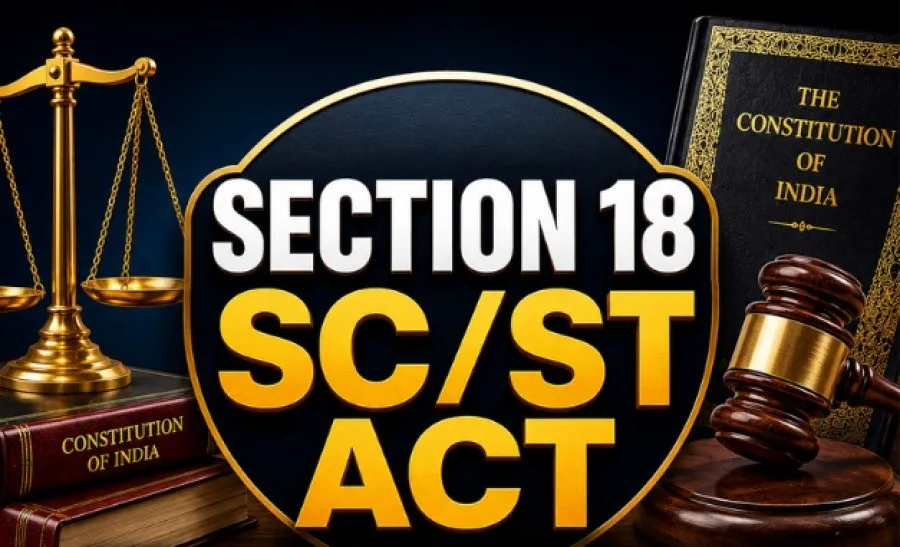
On this page
Balancing Legislative Intent and Personal Liberty: How the Supreme Court Navigates the Fine Line Between Protecting Marginalized Communities and Preventing Vexatious Prosecutions
A Comprehensive Blueprint of Pre-Arrest Protection, Statutory Safeguards, and Judicial Interpretations Under Modern Criminal Law Frameworks
By Legal Editor
New Delhi: October 10, 2026:
The Scheduled Castes and the Scheduled Tribes (Prevention of Atrocities) Act, 1989 (commonly known as the SC/ST Act) stands as a foundational legislative shield in India. Enacted pursuant to constitutional mandates under Articles 15, 17, and 21, the statute was designed with a vital objective: to protect members of historically marginalized communities from discrimination, social humiliation, and systematic violence, while ensuring speedy justice, rehabilitation, and the creation of exclusive special courts.
However, the intersection of this special penal statute with general criminal jurisprudence—specifically regarding personal liberty and pre-arrest protection—has been a subject of intense legal scrutiny. At the heart of this debate lies Section 18 of the SC/ST Act, which explicitly bars the application of anticipatory bail provisions to persons accused of committing offenses under the Act.
Over the decades, courts across India—led by landmark rulings of the Supreme Court—have grappled with a complex question: Is this bar absolute under all circumstances, or do narrow, well-defined exceptions exist to protect individuals from arbitrary or malicious state action? This extensive investigative and legal report examines the anatomy of Section 18, the evolution of judicial exceptions, its transition under the new criminal codes, and what litigants must know when navigating this high-stakes legal terrain.
Part I: The Anatomy of Section 18 and the Legislative Intent
To comprehend the legal hurdles associated with pre-arrest bail under the SC/ST Act, one must analyze the text and purpose of Section 18.
What Does Section 18 Mandate?
Section 18 of the 1989 Act states that nothing in Section 438 of the Code of Criminal Procedure, 1973 (CrPC)—which governed anticipatory bail—shall apply in relation to any case involving the arrest of any person on an accusation of having committed an offense under the Act. With the enactment of the Bharatiya Nagarik Suraksha Sanhita, 2023 (BNSS), which replaced the CrPC, anticipatory bail is now governed by Section 482 of the BNSS. Consequently, the statutory bar seamlessly extends to preclude pre-arrest protection under the new legal framework.
The Rationale Behind the Bar
The legislature introduced this absolute-sounding bar based on compelling social realities:
- Power Asymmetry: Parliament recognized that victims belonging to Scheduled Castes and Scheduled Tribes historically faced severe intimidation, social ostracization, and pressure from dominant social or economic groups. Granting pre-arrest bail easily could give accused individuals an opportunity to tamper with evidence, threaten witnesses, or coerce victims into compromising settlements.
- Deterrence: The gravity of caste-based atrocities necessitates an uncompromised institutional response where custodial interrogation may be deemed essential by law enforcement agencies to unearth the truth of a crime.
The 2018 Amendment and Section 18A
Following certain judicial interpretations that sought to dilute immediate arrests, Parliament enacted the Scheduled Castes and the Scheduled Tribes (Prevention of Atrocities) Amendment Act, 2018, which introduced Section 18A. This provision explicitly clarified that:
- A preliminary inquiry is not required for registering an First Information Report (FIR) under the Act.
- The investigating officer is not required to seek approval or permission for the arrest of an accused person.
- The bar against anticipatory bail (Section 18) applies notwithstanding any judgment, order, or direction of any court.
As reported by LawBeat and analyzed across various judicial forums, the statutory intent was to reinforce the unyielding nature of the protective framework.
Part II: The Judicial Exception—The Prima Facie Doctrine
Despite the sweeping text of Section 18, the Supreme Court of India recognized that an absolute, unyielding bar could occasionally lead to grave injustices, particularly in instances of personal vendettas, property disputes, or political rivalries where false accusations under the Atrocities Act might be weaponized.
To balance statutory protection with constitutional guarantees of personal liberty (Article 21), the judiciary carved out a vital, narrow exception: the absence of a prima facie case.
Landmark Precedent: Prathvi Raj Chauhan v. Union of India (2020)
In the landmark case of Prathvi Raj Chauhan v. Union of India (2020), a bench of the Supreme Court upheld the constitutional validity of Section 18 and Section 18A introduced by the 2018 Amendment. However, the Apex Court simultaneously clarified a critical safety valve:
- If a complaint or FIR does not disclose a prima facie case constituting an offense under the SC/ST Act, the bar under Section 18 and Section 18A will not apply.
- In such exceptional scenarios, regular constitutional courts (Sessions Courts and High Courts) retain the jurisdiction to entertain and grant anticipatory bail under Section 482 of the BNSS (formerly Section 438 CrPC).
Subsequent rulings by various High Courts—such as the Himachal Pradesh High Court in Sahil Sharma v. State of Himachal Pradesh—and Supreme Court pronouncements like Shajan Skaria v. State of Kerala (2024) have consistently reiterated this principle: If the essential ingredients of an offense under the Atrocities Act are missing from the allegations, the statutory bar collapses, and pre-arrest bail can be considered.
Part III: Decoding When a Prima Facie Case is Absent
To successfully secure anticipatory bail despite Section 18, a defence counsel must demonstrate that the allegations fail to meet the legal thresholds of the statute. Courts look for specific indicators to determine whether the bar applies:
1. Lack of Intentional Public Humiliation
Under Section 3(1)(r) and 3(1)(s) of the Act, an offense requires an intentional insult or intimidation with intent to humiliate a member of a Scheduled Caste or Scheduled Tribe in any place within public view.
- The Exception: If the alleged altercation occurred inside a private, locked room not visible or audible to the public, or if the words spoken had no nexus to the complainant's caste identity, the core ingredient of the offense fails. As noted by legal experts tracking judgments on Drishti Judiciary, an FIR that completely lacks a caste-based motive or context cannot attract the bar of Section 18.
2. Pre-existing Civil, Property, or Matrimonial Disputes Given a Criminal Hue
It is a well-documented phenomenon in criminal litigation that pre-existing civil litigations, landlord-tenant disputes, business disagreements, or family feuds are occasionally converted into criminal complaints invoking the SC/ST Act to exert pressure.
- The Exception: When courts find clear documentary evidence (such as ongoing property injunction suits, WhatsApp chats, or financial agreements predating the FIR) demonstrating that the Atrocities Act provisions have been invoked vindictively, courts pierce the veil of the FIR and hold that the statutory bar does not operate.
3. Vague, General, and Omnibus Allegations
An FIR that makes sweeping, generalized accusations without naming specific overt acts attributed to individual applicants often fails the prima facie test. If the complaint reads like a generic template without detailing specific dates, times, or utterances, courts are inclined to review the matter for pre-arrest relief.
Part IV: Procedural Dynamics Under the BNSS and Recent Supreme Court Rulings
With the transition to the Bharatiya Nagarik Suraksha Sanhita, 2023 (BNSS), criminal procedure in India has entered a modernized phase.
Mechanical Application of the Bar is Prohibited
In several recent pronouncements, including rulings highlighted by legal analysts at Hindustan Times, the Supreme Court cautioned trial courts and High Courts against applying the Section 18 bar in a mechanical, blanket fashion.
- Courts must not assume that the mere mention of the acronym "SC/ST Act" in an FIR instantly shuts the doors of justice for anticipatory bail.
- Judges are duty-bound to examine the four corners of the FIR and accompanying case diaries to verify whether the factual matrix actually discloses an atrocity, or if it represents an abuse of the judicial process.
The Strict Threshold for Relief
While exceptions exist, legal practitioners emphasize that the threshold for obtaining anticipatory bail in an SC/ST Act matter remains exceptionally high. The burden lies heavily on the applicant to establish clear, undeniable malafides or a total absence of statutory ingredients. Merely claiming innocence or stating that a dispute is civil in nature is insufficient unless supported by sterling documentary proof at the threshold stage.
Landmark Case Law Reference Table
Case Name & Citation | Core Legal Ruling on Section 18 & Anticipatory Bail |
|---|---|
Prathvi Raj Chauhan v. Union of India (2020) | Upheld the constitutional validity of Sections 18 and 18A, but authoritatively established that if no prima facie case is made out under the Atrocities Act, the bar on anticipatory bail does not apply. |
Shajan Skaria v. State of Kerala (2024) | Reiterated that anticipatory bail is maintainable under Section 438 CrPC / BNSS if the allegations in the complaint, taken at face value, do not satisfy the statutory ingredients of an SC/ST Act offense. |
Kiran v. Rajkumar Jivraj Jain (2025) | Emphasized that where specific, targeted casteist abuse occurs in public view, Section 18 creates an absolute bar, and High Courts must not grant anticipatory bail lightly by misinterpreting false implication. |
Sahil Sharma v. State of Himachal Pradesh (2025) | Highlighted that an FIR lacking a clear caste-based motive or emerging from a pre-existing dispute cannot invoke the absolute protective bar of Section 18 to deny pre-arrest protection. |
Frequently Asked Questions (FAQs)
1. Does Section 18 of the SC/ST Act completely ban anticipatory bail in every case?
No. While Section 18 creates a strong statutory bar against granting anticipatory bail for offenses under the Act, the Supreme Court (Prathvi Raj Chauhan v. Union of India) ruled that if the complaint or FIR fails to disclose a prima facie case, the bar does not apply, and courts can entertain pre-arrest bail applications.
2. Which section governs anticipatory bail now that the CrPC has been replaced?
Anticipatory bail is now governed by Section 482 of the Bharatiya Nagarik Suraksha Sanhita, 2023 (BNSS), which replaced Section 438 of the old Code of Criminal Procedure, 1973. The statutory restrictions of Section 18 of the SC/ST Act continue to apply directly to applications filed under Section 482 BNSS.
iPleaders
3. What are the primary grounds to argue that no prima facie case is made out?
Defence lawyers typically argue that:
- The alleged incident did not occur within "public view."
- There is no mention of caste-based slurs or intent to humiliate in the original FIR.
- The complaint stems from an underlying property, monetary, or personal dispute that has been given a false caste colour.
- The allegations are vague, general, and lack specific details regarding the applicant's role.
4. Can a preliminary inquiry be insisted upon before filing an FIR under the SC/ST Act?
No. Section 18A(a) explicitly clarifies that a preliminary inquiry is not required by the police for registering an FIR under the Atrocities Act, and investigating officers do not need prior approval to make arrests.
5. If my anticipatory bail application is rejected by the Sessions Court, where should I appeal?
If the Sessions Court rejects an anticipatory bail application, the aggrieved person can move the respective High Court under Section 482 of the BNSS. However, convincing the High Court requires demonstrating clear legal infirmity, lack of prima facie materials, or manifest arbitrariness in the lower court's order.
Related articles
 Anticipatory Bail
Navigating Anticipatory Bail: Balancing Law Enforcement Needs with Protection from Harassment and Arbitrary Arrest
This article explores the concept of anticipatory bail in India, detailing its legal foundation, judicial evolution, and the balance it strikes between personal liberty and law enforcement necessity.
7 min read
 Anticipatory Bail
News Snacks
This article examines the Supreme Court's recent ruling granting anticipatory bail in a Rs 1.3 crore cheating case, highlighting the intricate balance between personal liberty and the integrity of investigations in economic offenses.
5 min read