Decoding Bail in GST Evasion and Fake Invoicing Scams: Legal Grounds, Statutory Thresholds, and Judicial Safeguards
This guide delves into the intricacies of bail in GST evasion and fake invoicing cases, outlining legal grounds, monetary thresholds, and essential judicial safeguards to protect taxpayers' rights.
- By
- BailNow Research Team
- Published
- Reading time
- 9 min read
On this page
Navigating Sections 132 and 69 of the CGST Act, Monetary Thresholds, and the Shift from Routine Arrests to Strict Judicial Scrutiny
From Prima Facie Evidence and Cooperation to Anticipatory Bail and PMLA Overlaps: A Comprehensive Guide for Taxpayers and Legal Professionals
By Legal Editor
New Delhi: October 08, 2026:
The Goods and Services Tax (GST) regime, introduced to streamline India’s indirect taxation landscape, has witnessed an intensified crackdown on financial fraud, particularly regarding fake invoicing and fraudulent Input Tax Credit (ITC) scams. Across the country, tax intelligence units and anti-evasion wings have ramped up investigations into "paper firms" or shell entities that generate invoices without any actual movement of goods or services solely to pass on bogus tax credits.
For businesses, chartered accountants, and corporate directors, understanding the legal mechanics of arrest and bail under the Central Goods and Services Tax (CGST) Act, 2017, has never been more critical. While tax authorities possess sweeping powers to enforce compliance and penalize defaulters, the judiciary increasingly insists that personal liberty cannot be curtailed arbitrarily through routine or premature custodial measures.
This comprehensive guide explores the statutory provisions governing GST offences, the strict monetary thresholds that dictate bailable versus non-bailable classifications, the core grounds on which courts grant bail, and the vital procedural safeguards shielding taxpayers from overreach.
Part 1: The Core Legal Architecture — Sections 132 and 69 Explained
To understand how bail works in GST evasion cases, one must first look at the foundational statutory provisions under the CGST Act. Section 132 defines the punishable criminal offences, while Section 69 empowers designated authorities to make arrests.
1. What Constitutes a Criminal GST Offence? (Section 132)
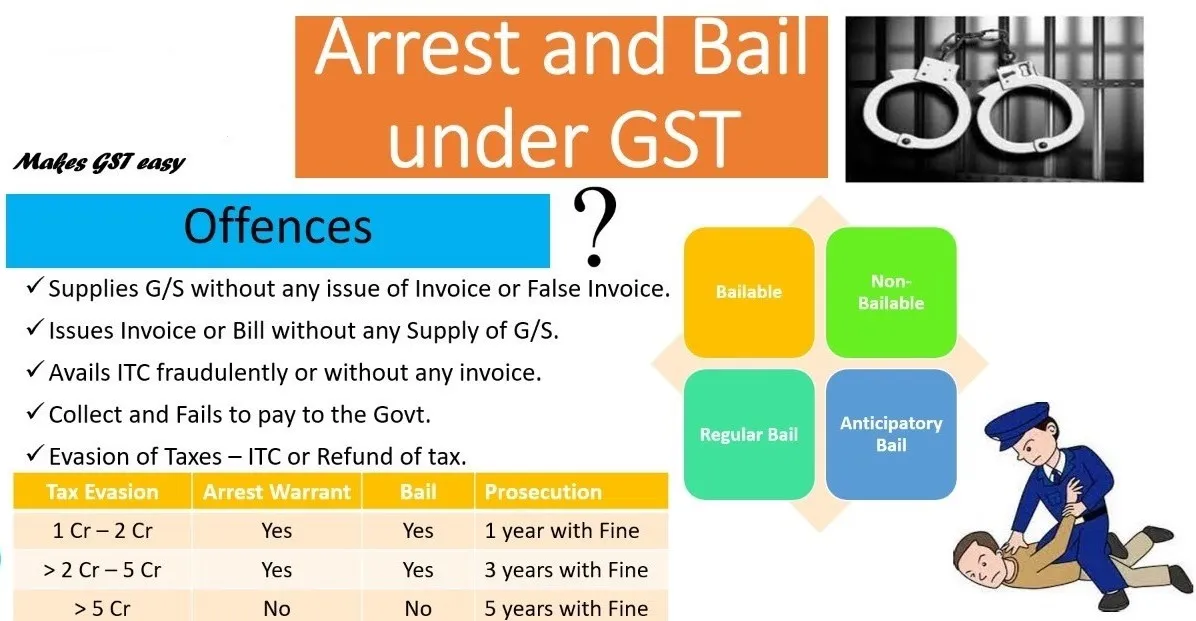
Section 132 of the CGST Act outlines several specific fraudulent activities that attract criminal prosecution:
- Issuing Invoices Without Supply: Issuing an invoice or bill without any actual supply of goods or services, leading to the wrongful availment or utilization of ITC.
- Fraudulent ITC Availment: Claiming Input Tax Credit using fake invoices or without any underlying bills.
- Supplying Without Invoices: Supplying goods or services without issuing an invoice with a deliberate intention to evade tax.
- Failure to Deposit Collected Tax: Collecting tax from customers but failing to deposit the amount with the government beyond a period of three months from the due date.
- Falsification of Records: Falsifying or destroying books of accounts, financial records, or documentation to conceal tax liabilities.
2. The Power to Arrest (Section 69)
Under Section 69 of the CGST Act, the Commissioner can authorize a designated officer to arrest any person if there are "reasons to believe" that the individual has committed a cognizable and non-bailable offence. This power is designed to target masterminds of fake billing networks, circular trading syndicates, and systematic revenue pilferage. However, the law mandates that arrest cannot be based on mere suspicion or speculation; it must be backed by tangible material evidence and recorded reasoning.
Part 2: The Monetary Thresholds — Bailable vs. Non-Bailable Offences
The severity of punishment and the availability of bail depend heavily on the quantum of tax evasion or wrongful ITC involved. Amendments over the years have structured these thresholds clearly:
Quantum of Tax Evasion / Fraudulent ITC / Refund | Classification of Offence | Bail Implications |
|---|---|---|
Up to ₹1 Crore | Bailable / Minor Threshold | Offences are bailable. Prosecution is generally avoided or handled through compounding and civil penalties. |
₹1 Crore to ₹2 Crore | Bailable | Carries imprisonment up to 1 year (with fine). Bail is a statutory right at the police station or magistrate level upon furnishing surety. |
₹2 Crore to ₹5 Crore | Bailable / Non-Cognizable (depending on specific clauses) | Carries imprisonment up to 3 years. Though punishable, offences remain bailable under specific interpretations but require careful legal navigation. |
Above ₹5 Crore | Cognizable and Non-Bailable | Carries imprisonment up to 5 years with fine. Bail is not a matter of right; it is entirely up to judicial discretion, requiring robust legal representation in Sessions or High Courts. |
Part 3: Key Grounds for Securing Bail in GST and Fake Invoicing Cases
When an accused individual is arrested or seeks anticipatory bail in a high-value GST fraud case (exceeding ₹5 crore), criminal defence lawyers rely on several well-established judicial grounds. Courts evaluate these parameters holistically:
1. Absence of "Reason to Believe" and Arbitrary Arrests
Section 69 requires an objective "reason to believe" that a cognizable offence has been committed. Courts have repeatedly held that arresting individuals without recording concrete satisfaction or justification renders the arrest illegal. For instance, if an arrest memo fails to specify the precise quantum of evasion or acts on generalized suspicion without primary corroboration, high courts routinely grant regular or interim bail.
2. Non-Quantification of Tax Evasion at the Time of Arrest
A recurring theme in recent judicial pronouncements (such as judgments from various High Courts) is that tax authorities must precisely quantify the alleged evasion before curtailing personal liberty. If the exact amount remains ambiguous or under subjective estimation during initial questioning, courts view immediate custodial detention as premature and arbitrary, favouring the release of the accused.
3. Cooperation with the Investigation
Cooperation with ongoing inquiries is a powerful mitigating factor. If an accused person has consistently responded to departmental summons under Section 70, provided books of accounts, digital logs, and explanation of supply chains, the necessity for custodial interrogation diminishes significantly. Supreme Court guidelines dictate that custodial interrogation should not be used as a punitive tool if the accused is willing to join the probe and furnish records.
4. Lack of Flight Risk and Rootedness in Society
Economic offence cases often hinge on whether the accused poses a flight risk. Demonstrating deep familial roots, established business premises, permanent residence, and absence of prior criminal antecedents heavily sways the judicial pendulum toward granting bail.
5. Stage of Investigation and Completion of Documentary Evidence
Once search operations are concluded, electronic devices (laptops, mobile phones) are seized, and statement recordings are complete, the investigative agency's argument for keeping a person behind bars weakens. Courts frequently observe that when the core evidence is already secured in documentary or digital form, prolonged pre-trial incarceration serves no meaningful investigative purpose.
Part 4: Procedural Safeguards and the Role of BNSS
The introduction of the Bharatiya Nagarik Suraksha Sanhita (BNSS) has reinforced procedural safeguards governing arrest and detention in India. Although economic offences under special statutes like the CGST Act retain their substantive penalties, their procedural execution must strictly align with modern statutory protections:
- Right to Know Grounds of Arrest: Under Section 47 of the BNSS, every arrested person must be promptly informed of the full grounds of their arrest and their entitlement to bail where applicable.
- Access to Legal Counsel: The right of an accused person to consult an advocate of their choice during interrogation is explicitly protected.
- Mandatory Production Before Magistrate: No person can be detained in custody beyond 24 hours without being produced before a Judicial Magistrate, ensuring independent judicial oversight over remand applications.
- Strict Compliance with Departmental Guidelines: Administrative guidelines—such as CBIC’s internal circulars and Instruction No. 2/2022-23—explicitly dictate that arrest should be an exception rather than the rule, restricted to scenarios involving deliberate defiance, active evasion, or threat of tampering with witnesses.
Part 5: The Compounding Option and Parallel PMLA Risks
1. Compounding of Offences (Section 138)
Under Section 138 of the CGST Act, most criminal offences can be compounded (settled) either before or after the institution of prosecution, upon payment of a compounding fee.
- The compounding fee typically ranges from 50% to 150% of the tax involved.
- While compounding terminates criminal proceedings, it is generally barred for repeat offenders or individuals involved in massive systemic fraud exceeding certain limits without statutory clearance.
- Importantly, paying the tax demand does not automatically extinguish criminal liability unless formal compounding or court clearance is secured, though it acts as a strong positive indicator during bail hearings.
2. The Shadow of the Prevention of Money Laundering Act (PMLA)
In massive fake invoice scams where "proceeds of crime" are generated through fraudulent ITC monetization, cases often attract the attention of the Enforcement Directorate (ED).
- GST offences that fall under the schedule of the PMLA can trigger parallel investigations.
- Securing bail under the PMLA is notoriously rigorous, requiring satisfaction of the twin conditions under Section 45 of the PMLA (where the court must be prima facie convinced that the accused is not guilty and is unlikely to commit any offence while on bail).
- Therefore, mounting an early, proactive defence during the initial GST summons stage is vital to prevent escalation into multi-agency money laundering prosecutions.
Frequently Asked Questions (FAQs)
Q1. At what monetary threshold does a GST offence become non-bailable?
A: Under Section 132 of the CGST Act, offences involving tax evasion, wrongful Input Tax Credit (ITC), or fraudulent refunds exceeding ₹5 crore are classified as cognizable and non-bailable. Below this threshold, offences are bailable or carry lesser legal gravity.
Q2. Can GST officers arrest a taxpayer without a judicial warrant?
A: Yes. Under Section 69 of the CGST Act, authorized GST commissioners and senior officers possess the statutory power to arrest an individual without a warrant, provided they have recorded "reasons to believe" that a cognizable and non-bailable offence has been committed.
Q3. Does paying back the disputed GST amount guarantee bail or end prosecution?
A: Paying the tax, interest, and penalty does not automatically close criminal prosecution. However, financial restitution significantly strengthens an application for regular or anticipatory bail and paves the way for formal compounding of offences under Section 138 of the CGST Act.
Q4. What documents are essential when applying for anticipatory bail in a fake invoice case?
A: Vital documents include verified GSTR filings, ledger accounts, e-way bills, lorry receipts (LR copies), toll plaza receipts, bank statements proving genuine commercial transactions, proof of active cooperation with investigating authorities, and records showing no prior criminal antecedents.
Q5. Can corporate directors and company signatories be arrested for company-level GST fraud?
A: Yes. Under Section 137 of the CGST Act, every person who was in charge of, and responsible to, the company for the conduct of its business at the time of the offence can be held personally liable and subjected to arrest if their complicity in fake invoicing or bogus ITC networks is established.
Related articles
 Bail Basics
Supreme Court Clarifies Judicial Boundaries: High Courts Cannot Direct Trial Courts to Grant Regular Bail on Preset Conditions While Rejecting Anticipatory Bail
The Supreme Court has clarified the limits of High Court powers during bail proceedings, emphasizing that trial courts must retain independent discretion in granting bail. This landmark ruling restores judicial balance within the Indian criminal justice system.
7 min read
 Bail Basics
Courts Must Be Wary of Granting Bail in Serious Offences During Trial: Supreme Court Sets a Strong Precedent
The Supreme Court of India stresses extreme caution in bail decisions during serious offence trials, especially when material witnesses remain unexamined.
7 min read