Understanding Liberty, Law, and State Power: A Comprehensive Guide to Arrest, Detention, and Preventive Detention in India
This article delves into the essential distinctions between arrest, detention, and preventive detention in India, highlighting constitutional safeguards and state powers.
- By
- BailNow Research Team
- Published
- Reading time
- 8 min read
On this page
Navigating the Boundaries of Personal Freedom, Criminal Procedure, and Constitutional Safeguards
By Legal Editor
New Delhi: October 20, 2026:
Personal liberty is one of the most cherished fundamental rights guaranteed by a democratic constitution. In India, Part III of the Constitution—particularly Articles 19 and 21—shields citizens from arbitrary state intrusion, ensuring that no person can be deprived of their life or personal liberty except according to procedure established by law.
However, maintaining public order, national security, and preventing imminent crimes requires the State to exercise coercive powers. When law enforcement agencies step in during protests, investigations, or perceived security threats, they use varying legal mechanisms. Terms like arrest, detention, and preventive detention are frequently used interchangeably in public discourse, but they carry distinct legal definitions, procedural safeguards, and constitutional implications.
1. Defining the Core Concepts
To understand how law enforcement interacts with citizens, one must examine the precise legal boundaries separating ordinary criminal process from state security actions.
A. What is an Arrest?
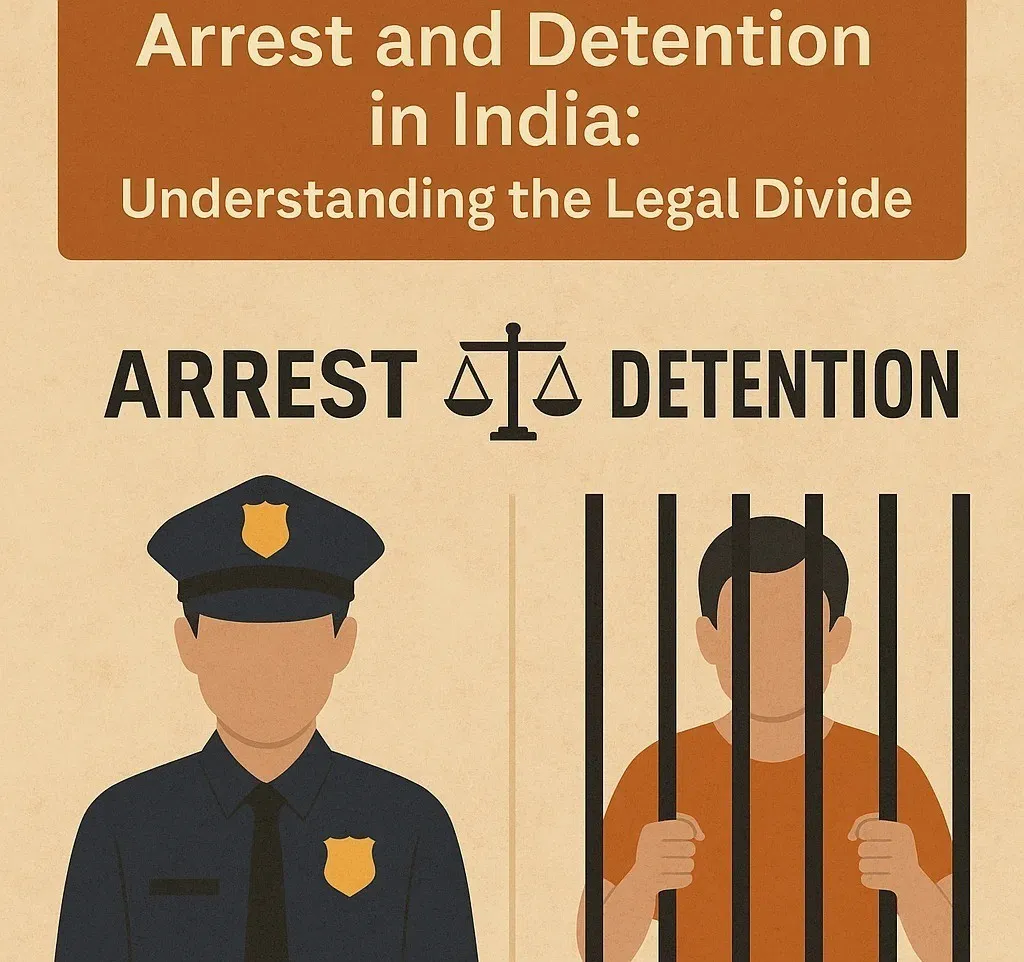
An arrest is the formal act of taking a person into custody because they are reasonably suspected of having committed a cognizable criminal offense.
- The Purpose: It marks the formal initiation of the criminal justice and investigative process.
- The Legal Outcome: Following an arrest, law enforcement must adhere to strict timelines—such as producing the accused before a judicial magistrate within 24 hours (excluding journey time), as mandated by Article 22(2) of the Constitution and statutory codes.
- Rights Triggered: An arrest immediately activates robust constitutional and statutory protections, including the right to be informed of the grounds of arrest, the right to legal counsel of one’s choice, and medical examination protections.
B. What is Detention (Short-Term / Precautionary)?
Detention, in the context of maintaining public order during protests or demonstrations, typically refers to a temporary holding measure used by police to prevent an imminent breach of peace or offense.
- Statutory Roots: While older codes like the Code of Criminal Procedure (CrPC) provided broad preventive powers, modern statutes like the Bharatiya Nagarik Suraksha Sanhita (BNSS)—which replaced the CrPC—provide explicit mechanisms. For instance, provisions like Section 170 of the BNSS allow police to act without a magistrate's order if they have design knowledge that a cognizable offense is about to be committed and cannot otherwise be prevented. Furthermore, provisions like Section 172 permit officers to detain or remove individuals who disregard lawful directions.
- The Distinction: Unlike an arrest, short-term detention is often precautionary rather than punitive or investigative. If a detained individual refuses to disperse or violates prohibitory orders (such as Section 163 of the BNSS), the detention can escalate into a formal arrest under penal provisions like Section 223 of the Bharatiya Nyaya Sanhita (BNS).
C. What is Preventive Detention?
Preventive detention stands entirely apart from ordinary criminal law. It involves holding a person without trial or conviction, not because they have committed a crime, but based on a reasonable apprehension that they might act in a manner prejudicial to the security of the State, public order, maintenance of supplies essential to the community, or foreign relations.
- Pre-emptive Nature: It is entirely detached from the regular penal system. The objective is not to punish past behaviour, but to incapacitate an individual from executing a future threat.
- Exclusion of Standard Rights: Persons held under preventive detention laws (such as the National Security Act or state-specific security acts) do not enjoy the standard Article 22(1) and (2) safeguards—such as production before a magistrate within 24 hours or the immediate right to an advocate during the initial advisory review phase.
2. Constitutional Framework: Article 22 and Personal Liberty
The Indian Constitution provides a dual framework under Article 22, balancing the rights of individuals accused of crimes against the sweeping powers of the State to execute preventive detention.
Safeguards for Punitive / Ordinary Arrest (Article 22(1) and (2))
- Right to Information: Every person who is arrested must be informed as soon as may be of the grounds for such arrest.
- Right to Counsel: The arrested individual has the right to consult and be defended by a legal practitioner of their choice.
- Production Before a Magistrate: The police must produce the detained or arrested person before the nearest judicial magistrate within 24 hours of arrest, ensuring judicial oversight over executive custody.
The Exception: Preventive Detention (Article 22(3) to (7))
Article 22 explicitly carves out exceptions for laws providing for preventive detention. However, to prevent absolute tyranny, the Constitution embeds specific counter-safeguards:
- Duration Limits: Ordinarily, a person cannot be detained under preventive detention for more than three months unless an Advisory Board (consisting of persons who are or have been judges of a High Court) reports sufficient cause for extended detention.
- Communication of Grounds: The detaining authority must communicate to the detainee the grounds on which the order has been made as soon as possible, affording them the earliest opportunity to make a representation against the order.
- Withholding Information: The Constitution permits authorities to withhold facts that they consider against the public interest to disclose.
3. The Evolving Legal Landscape: BNSS and Public Order
With the replacement of legacy criminal laws by the BNSS and BNS, police powers regarding public assemblies and crowd control have experienced structural adjustments.
Managing Public Assemblies and Protests
When large-scale demonstrations occur—such as rallies demanding administrative accountability or policy changes—local administrations frequently issue prohibitory orders (e.g., Section 163 of the BNSS).
- Law Enforcement Duty: Police are legally mandated to maintain public order. If protesters defy lawful orders to disperse, law enforcement possesses the statutory authority to remove or temporarily hold (detain) individuals to neutralize immediate threats to public safety.
- Judicial Precedents: Courts, including landmark observations by the Supreme Court (such as in Mazdoor Kisan Shakti Sangathan v. Union of India), have consistently reiterated that while citizens possess a fundamental right to freedom of speech and expression (Article 19(1)(a)) and peaceful assembly (Article 19(1)(b)), these rights are subject to "reasonable restrictions" in the interest of public order under Articles 19(2) and 19(3). Protests must remain peaceful, unarmed, and compliant with reasonable regulatory parameters set by local authorities.
Frequently Asked Questions (FAQs)
Q1: What is the main difference between an arrest and detention?
A: An arrest is a formal deprivation of liberty linked directly to the commission of a specific crime, initiating the formal criminal investigation and judicial process. Detention, particularly in public order scenarios, is often a short-term, precautionary measure used by police to prevent an imminent offense, manage crowds, or enforce lawful dispersal orders without immediately launching a criminal case.
Q2: Can a person held under preventive detention demand a lawyer immediately?
A: No. The standard constitutional safeguards that guarantee the right to consult and be defended by a legal practitioner—as well as production before a magistrate within 24 hours—do not apply to individuals held under preventive detention laws. Preventive detainees must rely on statutory representation rights before Advisory Boards rather than immediate criminal trial defences.
Q3: What is the maximum period a person can be kept under preventive detention without review?
A: Under the Indian Constitution (Article 22(4)), a person cannot be detained for longer than three months unless an Advisory Board reviews the case and approves an extension before that period expires.
Q4: Are the rights to freedom of speech and peaceful assembly absolute in India?
A: No. Articles 19(2) and 19(3) of the Constitution permit the State to impose "reasonable restrictions" on free speech and peaceful assembly on specific grounds, including the sovereignty and integrity of India, security of the State, friendly relations with foreign states, public order, decency, or morality.
Q5: What happens if a person refuses to follow police dispersal orders during a protest?
A: Defying lawful prohibitory orders (such as those issued under Section 163 of the BNSS) can lead police to temporarily detain or remove the individuals. Furthermore, disobedience can constitute a substantive offense under provisions like Section 223 of the BNS, at which point short-term detention can legally transition into a formal criminal arrest accompanied by a First Information Report (FIR).
Related articles
 Criminal Procedure
News Snacks
The Supreme Court of India expunged adverse remarks against IPS officer A. Arun, reinforcing the need for accountability in preventive detention and ensuring individual liberty is prioritized.
4 min read
 Criminal Procedure
Knowing Your Shield: A Comprehensive Handbook on What to Do, What Not to Do, and Your Inalienable Rights When Arrested in India
Navigate the complexities of an unexpected police encounter with our comprehensive handbook. Understand your rights and the protocols you should follow during an arrest in India to ensure your personal liberty is protected.
10 min read