News Snacks
The Supreme Court of India emphasized trial court authority by directing UAPA accused Shadab Ahmed's plea for educational bail modification back to the trial court, highlighting the balance between legal restrictions and personal reform.
- By
- BailNow Research Team
- Published
- Reading time
- 4 min read
On this page
Navigating the Boundaries of Liberty: Supreme Court Directs Delhi Riots UAPA Accused Back to Trial Court Over Educational Plea
Judicial Prudence vs. Personal Reformation: Balancing Strict UAPA Bail Restrictions with Academic Pursuits
The Jurisdictional Debate: Why the Apex Court Insisted on Trial Court Intervention for Bail Condition Modifications
By Legal Reporter
New Delhi: October 26, 2026
The Supreme Court of India recently reinforced procedural hierarchy in high-profile criminal jurisprudence by refusing to entertain a plea filed by Shadab Ahmed, an accused under the stringent Unlawful Activities (Prevention) Act (UAPA) in the 2020 Delhi riots larger conspiracy case. A bench comprising Justice Aravind Kumar and Justice Vipul M. Pancholi disposed of the petition as withdrawn, granting the applicant liberty to approach the Trial Court for modification of his bail conditions to attend law classes in Ghaziabad.
This analytical report examines the legal dimensions of the ruling, the tension between statutory bail limitations and individual reformation, and the procedural pathway mandated by the apex court.
Analytical Overview: The Legal Impasse
Shadab Ahmed, who secured regular bail alongside other co-accused in January 2026 under the UAPA framework, moved the Supreme Court via a miscellaneous application. His legal counsel argued that Ahmed was on a definitive path of "reformation" after securing admission to a three-year law course at a university in Ghaziabad, located approximately 10 kilometers from the National Capital Territory of Delhi (NCTD).
The core friction centered around two primary bail conditions imposed by the apex court:
- Territorial Restriction: Prohibition against leaving the NCTD without prior permission from the Trial Court.
- Reporting Mandate: The requirement to physically mark attendance before the Station House Officer (SHO) of the Crime Branch, Delhi Police, twice a week (Mondays and Thursdays).
Ahmed’s counsel contended that attending classes on specific days required relaxing these rigid parameters, noting that attempts to secure admission within Delhi institutions had proved unsuccessful. However, the bench remained firm on judicial discipline, questioning why the applicant bypassed the Trial Court and directly approached the Supreme Court for modifications that could logically fall within local judicial oversight or require foundational evaluation at the grassroots judicial tier.
Jurisdictional Propriety and Judicial Discretion
The apex court’s stance highlights a crucial tenet of Indian criminal procedure: trial courts are primary custodians of an ongoing trial and the direct supervisors of executed bail bonds. When superior courts impose composite bail conditions under special statutes like the UAPA, subsequent administrative relaxations—such as temporary movement for educational or occupational necessities—are ideally vetted first by the court that monitors day-to-day compliance.
By directing Ahmed back to the Trial Court, the Supreme Court re-emphasized that trial courts possess the administrative bandwidth to evaluate localized adjustments, verify academic schedules, and balance personal progression against public safety parameters.
Frequently Asked Questions (FAQs)
1. Why did the Supreme Court refuse to modify Shadab Ahmed's bail conditions directly?
The Supreme Court maintained that applications seeking modifications of bail conditions—such as relaxing territorial limits or reporting frequencies—should first be evaluated by the local Trial Court, which monitors the daily execution of bail bonds and compliance.
2. What are the specific bail conditions Ahmed sought to change?
Ahmed sought modifications to condition number (ii), which bars him from leaving the NCTD without prior judicial permission, and condition number (v), which mandates reporting to the Delhi Police Crime Branch office twice a week.
3. What legal statute is involved in the Delhi riots larger conspiracy case?
The accused persons are prosecuted under the stringent Unlawful Activities (Prevention) Act (UAPA) alongside various provisions of the Indian Penal Code (IPC) relating to the February 2020 civil unrest in the national capital.
4. What was the final outcome of the Supreme Court hearing?
The Supreme Court dismissed the miscellaneous application as "withdrawn" while explicitly granting Ahmed the liberty to approach the Trial Court with his request.
Related articles
 UAPA Bail
News Snacks
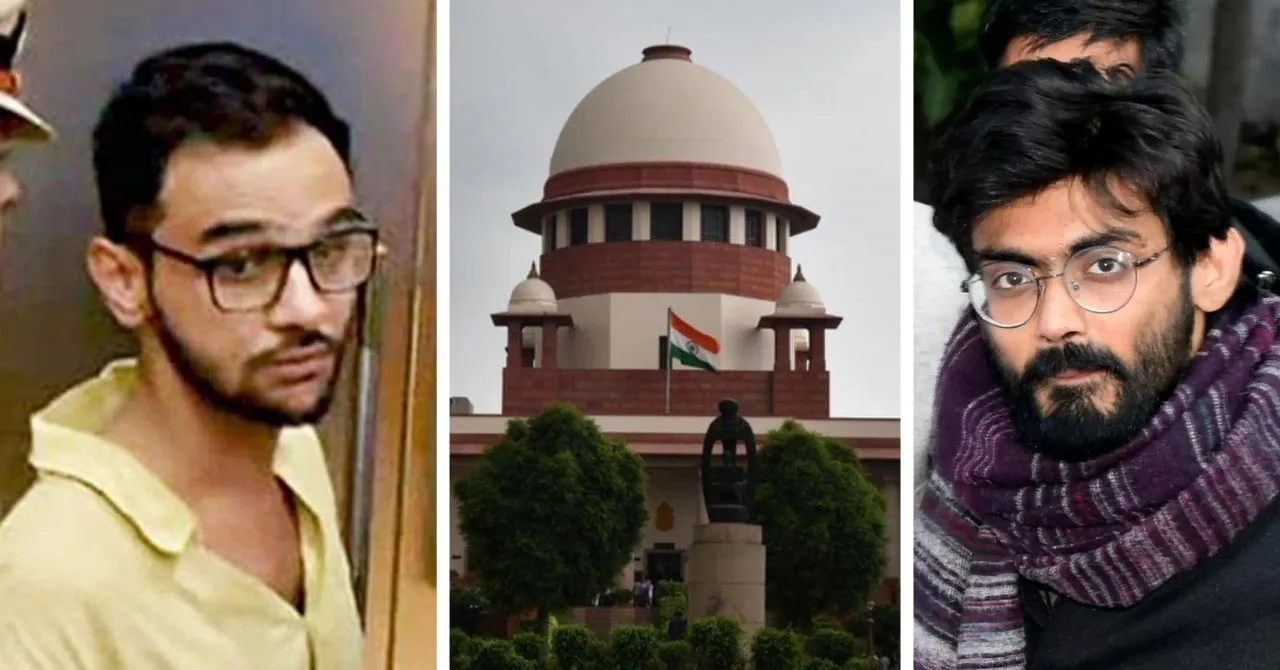
Umar Khalid and Sharjeel Imam have approached the Supreme Court challenging the Delhi High Court's refusal of their bail pleas in the northeastern Delhi riots case. Their prolonged imprisonment brings significant legal questions into focus, particularly concerning their rights as undertrials under UAPA.
4 min read
 UAPA Bail
Supreme Court Pulls Up Bihar Police and Gaya Court Over 14-Month Detention Without Production of UAPA Accused
The Supreme Court intervened in a case involving a UAPA accused detained for 14 months without production in court, demanding accountability from Bihar Police. The court granted interim bail pending further hearings.
6 min read